


Thro evening shades I haste away
To close the Labours of my Day
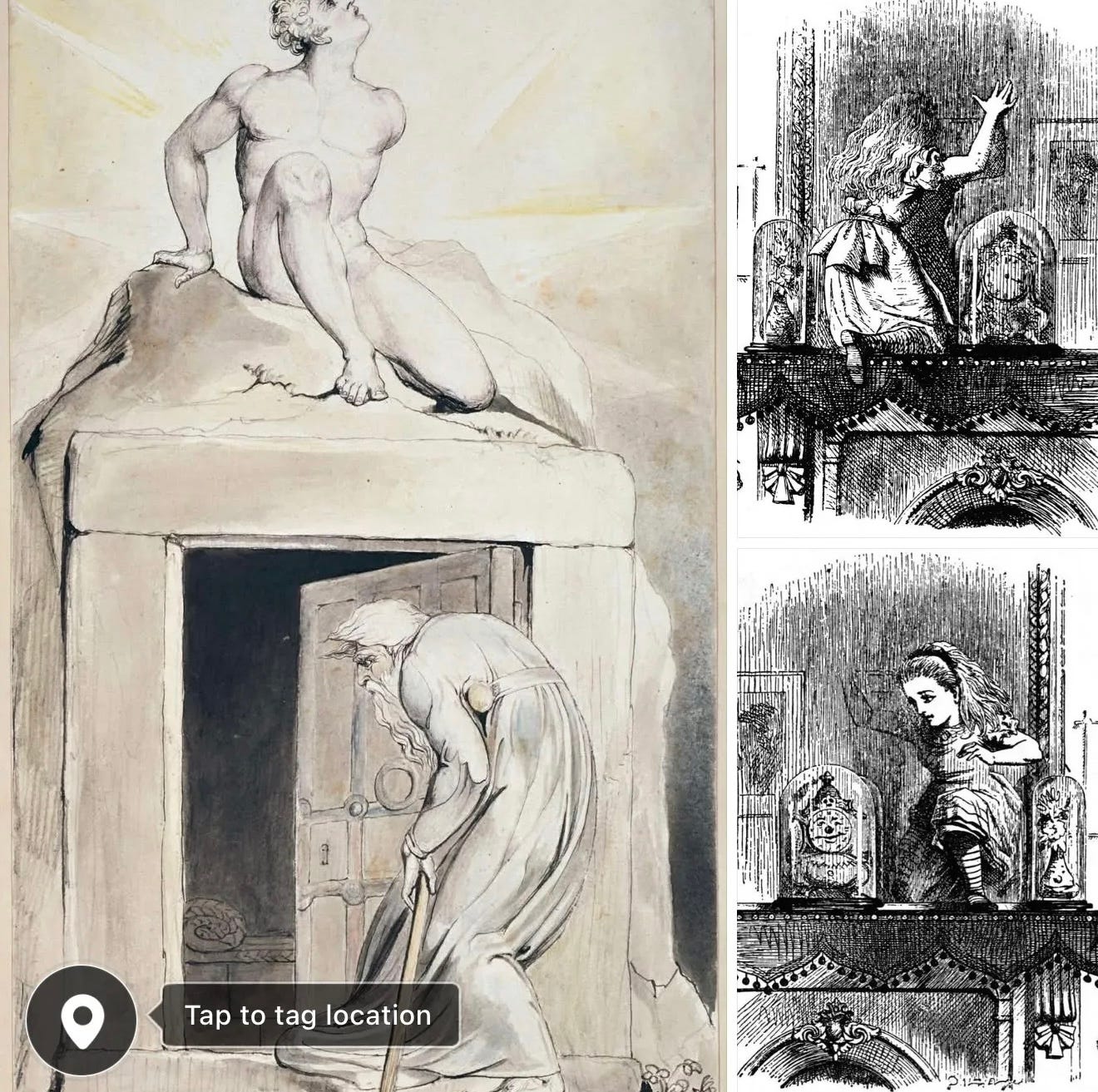
William Blake, The Traveller Hasteth in the Evening (1793).1
My childhood bends beside me. Too far for me to lay a hand there once or lightly... Secrets, silent, stony sit in the dark palaces of both our hearts: secrets weary of their tyranny: tyrants, willing to be dethroned.
James Joyce, Ulysses
I had a tenacious faith in myself, a Messiah as yet without a message who would one-day assemble a unique identity out of this defective jigsaw.
‘Blake’, in J G Ballard, The Unlimited Dream Company


t/w death: a caveat on delays
Rise up nimbly and go on your strange journey to the ocean of meanings. Leave, and don't look away from the sun as you go.
Rumi, Mathnawi

This post concerns an impending death; my own. My recent diagnosis (Mar 4ᵗʰ) is both complicated, but also typical of a stage four lung cancer (metastatic cancer), if I understand it right, with the cancer identifying itself only weeks ago, and further growths identified since then: I have tumours in the legs, lymph nodes and adrenal glands; a 4.5 cm tumour on the left lung is crowding out the nearby aorta; it has sprouted a smaller (11 mm) tumour on the right lung too; and colonies have set up camp in the cerebellum. A round of CT (Computed Tomography), MRI (Magnetic Resonance Imaging), X-Ray, EBUS (Endobronchial Ultrasound), and PET (Positron Emission Tomography) scan results is still being analysed. New facts emerge. I’m only just weeks into things and counting.
The core of the cancer—the in situ neoplasm: lodged lungwards near the heart—will have been lurking a while, silently sliming me up from within—every bit as game as myself, to be fair. With so many interactions possible between affected organs, anything might happen. That’s the picture I get. I may be with you for a long time yet, or I may not.
Someone with this prognosis is already a little less than human by today’s reckoning, because tucked back into time-on-loan, dashed into the ocean of ‘getting on with it’ and ‘bearing up’. Of course, we are all now ‘tucked back into time’ by virtue of being born at all (or so everyone seems convinced since the Enlightenment, at least). But in a cancer diagnosis, the limitation is seen as constitutive: to your peers, you are now increasingly seen to be that limit. If you don’t believe me, you may be shocked by the insistence with which people raise the issue of the effectiveness of your treatment and its deadlines.
The thing I want to get at first is how quickly I accepted, and even welcomed, the judgment, and looked straight to the end. In my own way, I felt blessed. My first thought was of Blake’s last moments, according to George Richmond, one of his young followers, ‘the Ancients‘: “He said He was going to that Country he had all his life wished to see & expressed himself Happy hoping for Salvation through Jesus Christ… He burst out in singing of the things he Saw in Heaven.”2
I guess you have just been made nervous by the traditional, sweaty, religiose-sounding talk of salvation “through Jesus Christ”, and its expectation of a resurrection “in the body”, which sounds at first glance as corny as any magician’s assistant hopping lightly from a wardrobe, having just been sawn in half. Bear with me.
“If deterioration seems rapid to you, you’ve probably not long to go”
I won’t dwell on the traditional funeral service talk of how “after my skin worms destroy this body, yet in my flesh I shall see God.” [Job 19:25-26] But let us note that, for Blake, this ‘body’—yours and mine alike—is the one body of Christ, Blake’s Lord God: “imagination or the Divine Body in Every Man.” I have written at length about this aspect of Blake’s thought, especially as it relates to theodicy and redemption in the Book of Job, and of the consequent liberatory, polysemic chaos Blake reaps for his understanding in engaging with the Canaanite Job, from ‘the land of Uz’. All talk of resurrection in what follows—a resurrection from which I fully expect to benefit—should be read in this light as a drop of temporarily, illusorily autonomous mind rejoining the cosmic ocean, “the mind lake”, and not merely bouncing back up on the table again.

The closest I’ve come yet to a human feeling for the end, as opposed to a marker projected further down the timeline, was from a consultant commenting that “if deterioration seems rapid to you, you’ve probably not long to go”; but if it seems slow, then—as Tweedle Dum or Dee might have said—”contrariwise: that’s Glory!!” Anyway, this week has been all about non-small cell carcinomas and their friends and emissaries.
As to how rapid my degeneration will be, you may decide from what follows, and get roughly as good an idea as I. A consultant just described a plausible course of chemotherapy, lasting around two years, which might be appropriate for my treatment, so that if I were to start soon and stay the course—and all went well—I’ll be around in two years from now. This was not a prediction, yet felt like a soothing expansion of an actuality that seemed wholly constraining just moments before. For an instant, I relaxed. That’s more or less how I’ve been taking in diagnostic information: fitfully, impressionistically.
”All shall be well, and all shall be well, and all manner of thing shall be well"
Julian of Norwich
Having spent years contemplating death on and off as the subject of several rounds of brain surgery, a stent-assisted coiling of an subarachnoid aneurysm (2005), bladder cancer (2014), a ranting philosopher, a lover of Blake’s most earthly of heavenly delights,3 and even a as a death doula trained with the Living Well, Dying Well Foundation, I’m not inclined to stop now, on its doorstep, but will hopefully see this through and talk about the experience as it happens, as best I can. The caveat is that I don’t want to catch friends tapping their watches, wondering when I will get on with the finalé for their benefit. If that prospect seems likely to frustrate you—forgive me. Things may drag on.
momentary diversions

It’s been a while since I posted on Substack (most recently, on David Bowie and the Droog Superior: Violence and the Dame—a theme as tightly coupled to my origins as a personality as this post hopefully will be about my uncoupling from the same), the time between being not so much busy as commandeered.
my life in a comic
The way they did the Bible
All the bubbles and actions
Little details in colorFirst a horseback bomber
(we’ll discover a star)
Then a small thin chance
Like seeing Jesus on Dateline
(like the stars in your eyes)Let’s face the music and dance
Don’t ever say I’m ready, I’m ready, I’m ready
David Bowie, New Killer Star


It started with a twist: a stitch, a burst of short-windedness, and some tight leg muscles while taking our dogs (Maggie & Stan) daily through Hackney to Abney Park Cemetery, Hackney Marshes and beyond, just three months ago.
Note that during this recent period, I felt pain nowhere but in my joints and muscles. This was unpleasant, of course, but gave no hint of anything seriously awry. The hard blows landed only in recent weeks, in quick succession, not always involving more pain. The leg pains grew until I had to take myself to the doctor and stop the dog’s walks. At an age in life when arthritis often hovers, I sought help.
Did all the talk of William Blake and prophecy, Christ, vision, the Ranters, and Christian communism prepare the traveller at all? Absolutely, yes I said yes It did Yes.
I already owe my life to the NHS several times over, as you will hear. But the topic now is not sickness and cancer as such, but of starting suddenly to peek spontaneously, as a result of the news, somehow, above those “dark palaces of our hearts,” (James Joyce, Ulysses) where previously we maybe sought to assemble Gillian Rose’s ‘defective jigsaw’ of our person to try to emerge whole above them—an unlikely coherence in the face of recalcitrant people and things—shuffling the palace furniture about, coming to terms with the new, trying to put down, resolve and evaporate old mysteries and find peace among the noise of death-in-life: “the only paradises cannot be those that are lost, but those that are unlocked as a result of coercion, reluctance, cajolery and humiliation” (Rose).4

The theme, then, is of how a lifetime of entangled regrets, trauma and abuse as a result of my family history, mutating, but never resolving, began to evaporate: that, plus the Buddhist Kati crystal tube, the Man of Light in Iranian Sufism (whether discussed specifically or not), altered states, ecstacy, Blake’s resurrection, and my own. How can biological metastasis induce Christian metanoia?5

Rose emphasised the necessity of this restless dialectic of framing the self, then navigating its implied challenge. More sympathetic to the flavour of Joyce’s epiphanies (and Joyce certainly being more in tune with Blake), I sought the transcendence of that struggle instead. The thing is, when the blows landed, I found myself immediately reconciled to the bottom-line outcome, death itself (if not all its ramifications, especially for my loved ones). As I emphasise throughout what follows, two worlds part ways spectacularly the moment anyone mentions the dreaded prognosis, asks me how I feel, or comments on my stoicism

This shift of gear is the issue. But as the medical verdict was handed down, was I in any better position to hear it than on the day I retired, five years ago, started this blog, and set off on the long voyage into the ‘evening’? Did the talk here of William Blake and prophecy, of Christ, vision, the Ranters, Surrealism, and Christian communism prepare the Traveller at all? Absolutely, yes I said yes It did Yes.
After a lifetime of endless hard-scrabble (they say), is there time for peace?
But I can’t show as much without setting this richness against the wearying medical processing, and the caring, noisome interpolation of others (‘how are you feeling?’). It is their comingled arising which best illustrates how two worlds, this and the next, are (not separating, but always actually) separated to regard each other: now and eternity.
After a lifetime of endless hard-scrabble (they say), is there time for peace? Can you close out your world of concerns and rise to meet the other in time (out of time?) Remarkably, more than I dared hope.
So, my claim is that my attempt to capture the absurdity of the news and its sense of closure it gave me must be set against a background of clattering walking sticks, family agendas, and missed appointments. Bear with me as I tour the hospital corridors and their visitors.

time boom x de devil dead!
God slew Satan and closed down hell / God slew the Russian and break this spell.
I am the Upsetter, still around. Lee Perry
My ship is sailing
Sri Krishna Prem6
At first, I spent weeks trying to get the local surgery to take my leg pains at all seriously. They encouraged me to rest. The statins prescribed for my blood pressure were stopped: “give it a month: we’ll see what happens.” I took co-codamol (paracetamol and codeine) for pain relief and got chronic constipation.

I also took to twisting medieval-looking steel massage rods and harrows into the muscles of my legs to soothe them at night, but the pain continued, and I lost sleep and weight. A round of acupuncture gave almost a day of blessed relief; £38 for half an hour’s pin-work on Lower Clapton Road. When my wife led me down to Homerton A&E one Saturday afternoon, an intern concluded that pain alone did not warrant further investigation: we could go home.
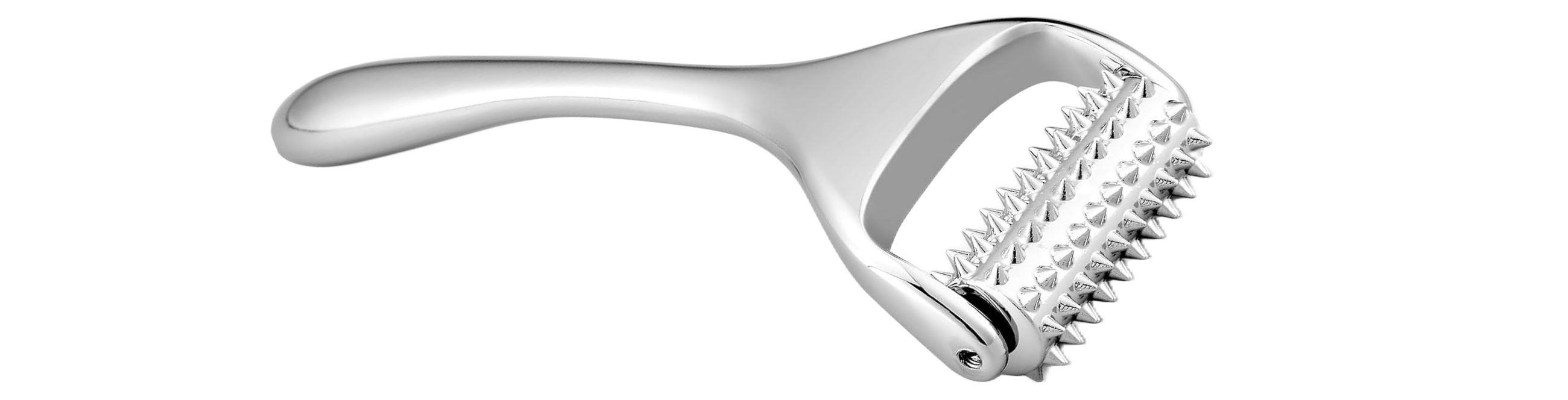
No one knows at this point, but the pain is caused by a metastasised tumour, parking itself in the left leg, pressing down on the adjacent bone, threatening to fracture it. The fracturing has yet to happen, and probably will not do so now we know what it’s up to, but the tumour itself drives on.7 Referred pains at this time shuttle all night between left and right legs, from knee to hip—perhaps there is something wrong with my spine, someone cheerfully offers.

I’ve been in remission from bladder cancer anyway for a decade now, monitored annually by endoscopy (they insert a live camera into the penis and scout around for deadly crumbs and sores: you watch all this happening on the handy trolley camera monitor as it takes place),8 but no one thinks to investigate a possible connection, what with the hip and bladder being neighbours. It turns out they are right: the bladder is not to blame. It is something else. Coincidentally, my next planned bladder scan is only a few weeks away now, likely headed for postponement.

I contacted the surgery once more to request a face-to-face meeting and, a few days later, finally received an invite for an on-site appointment at two-thirty in the afternoon. The surgery normally takes about ten minutes’ walk, so I get my crutches and set off with time to spare. Upon arrival, I register with the admissions system at the gate, submit my date of birth and postcode, and receive instant confirmation: I have a two-thirty appointment as advertised, and can proceed to wait.
As I’d manfully put in a bit of a sprint with the crutches, in my enthusiasm at the thought of being seen, I managed to arrive fifteen minutes early, so It is around two-fifteen now. I sit on one of the plastic chairs found in any such waiting room, putting only small pressure on my back, rocking gently while reading a book. Two-thirty arrives: two-forty. But I‘m not called. It is only a ten-minute wait, and there really is a lot of need around here. Soon it is ten minutes to three, then three o’clock. I am tired.

I approach the reception area again, explaining that, as I’m partially deaf, even though wearing my hearing aid, I often miss being called over the waiting-room tannoy. Could they check? They do so, returning to explain that the texted invitation from the surgery’s appointment system for an appointment at the surgery at two-thirty does not mean having actually to attend surgery. No—for my convenience, they will call me by phone.
I point out that it’s now just gone three pm, and I obviously have received no call. I am told that the allotted time is only ‘indicative’, as the doctors cannot always make time precisely, because, of course, they are so busy. I am free to go home and await the call. Someone did call. I think possibly this was the point at which a scan was finally arranged, which is what I wanted.

I tell you this, not to bemoan bureaucracy again, but to set the scene for comparing two worlds. The point about any problems with the NHS is not that they are so terrible, but that they are problems of this world we are taught to see as the inevitable price of continuing under late capitalism (or however you like to characterise Urizen’s dens: Egypt, Babylon, and the rest, where Urizen is a key figure in Blake’s mthology of control). This becomes clearer each day as time passes in this mode. The split between outer and inner worlds is a peeling apart that can only properly be experienced piecemeal, perhaps necessarily a little wearisomely. I’ll carry on telling the tale of how the juggernaut of mortal news let loose through such tiny rips, mishearings, fumblings, excuses and the like. The point is not to run down the NHS but to mind the gap between what is happening clinically and how it rebounds within.
In one world, there are appointments: people ask you how you are, where it hurts, how you feel, and whether you would like tea. Have you taken any painkillers or coagulants today? Laxatives? Are you being collected? Did you ever get the feeling you’ve been cheated?

At the same time, in the new world blowing through, the thoughts and feelings of many years may reassemble and even begin to settle down at last. It is this I want to reflect on, if I can. But I need to establish the space between worlds, even as they overlap endlessly in discussion with friends and loved ones, medical staff, and the curious… like M-branes colliding. There is parallax at play, new conjurations of feeling, and uprisings of old states of the self looking for recognition and absolution.
At last, an appointment has now been made at the Homerton Hospital for an initial CT scan to investigate possible fracturing of the femur at the most painful area of my leg. In the radiation department, I’m kitted out with a gown with some dramatic blood stains spilt down the front, and left to try it on. A young and friendly nurse helps me clamber onto the table for the scan. Once done, I‘m unbundled back into the same attached cubicle to dress. There are no staff around now that I can see, but another, fitter, patient sees my plight and picks up the basket of my clothes left on the floor in the corridor and passes it to me. I dress and find my way out of the radiology department, out of the Homerton, onto the night bus.

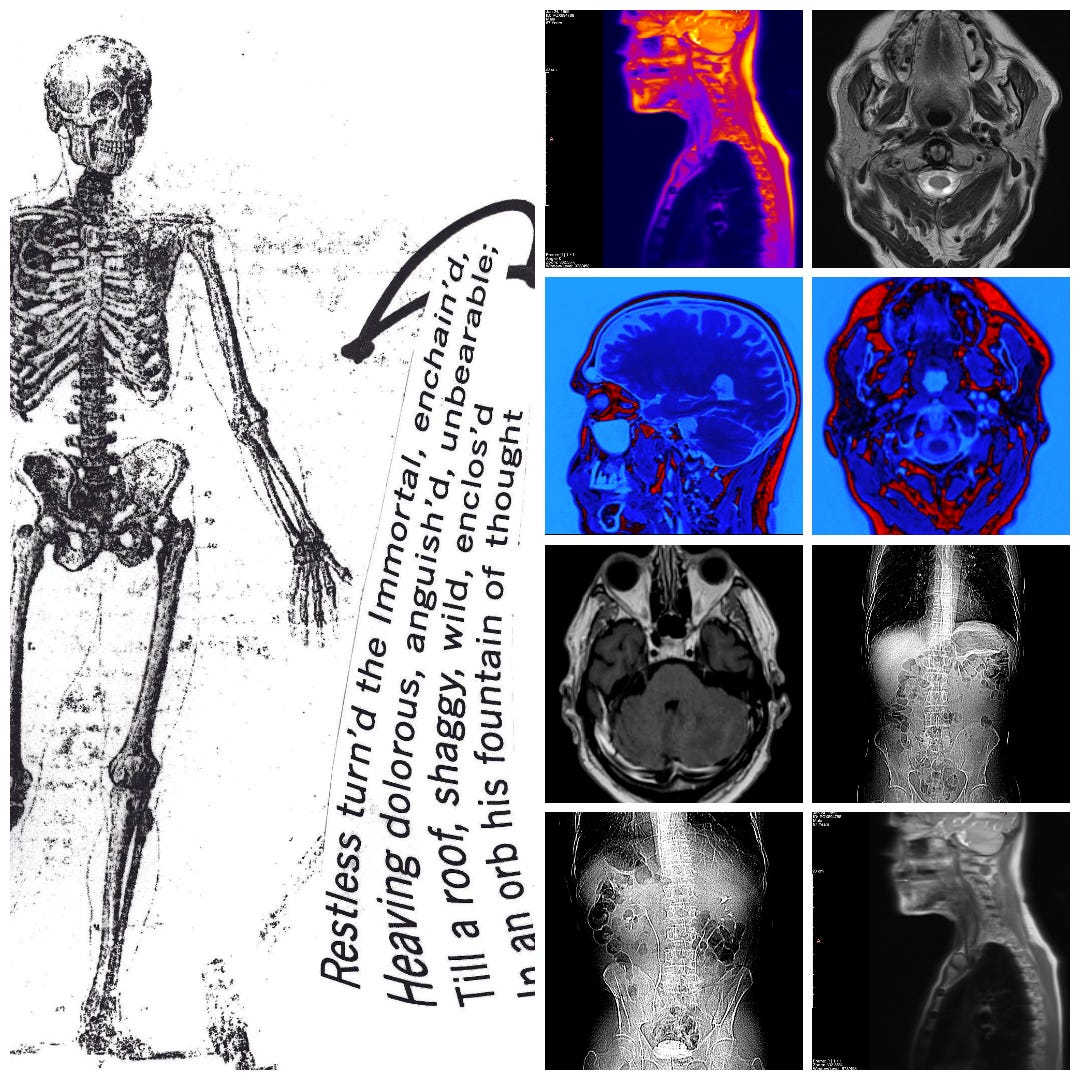
A PET scan is organised a few days later, at St Barts Hospital, in the shadow of St Paul’s. The body is flooded with a tracer radioactive fluid, after which you are locked into a lead-lined box for three-quarters of an hour to allow it to bake in. The scanner then detects where the tracer has been absorbed by cell growth anywhere in the body it is directed, producing reams of flowing light captured to film, copies of which—scans of my own body—are used throughout this post.
bodies of light
The Atoms of Democritus
And Newtons Particles of light
Are sands upon the Red Sea shore
Where Israel’s tents do shine so bright
William Blake, ‘Mock on Mock on Voltaire Rousseau’9
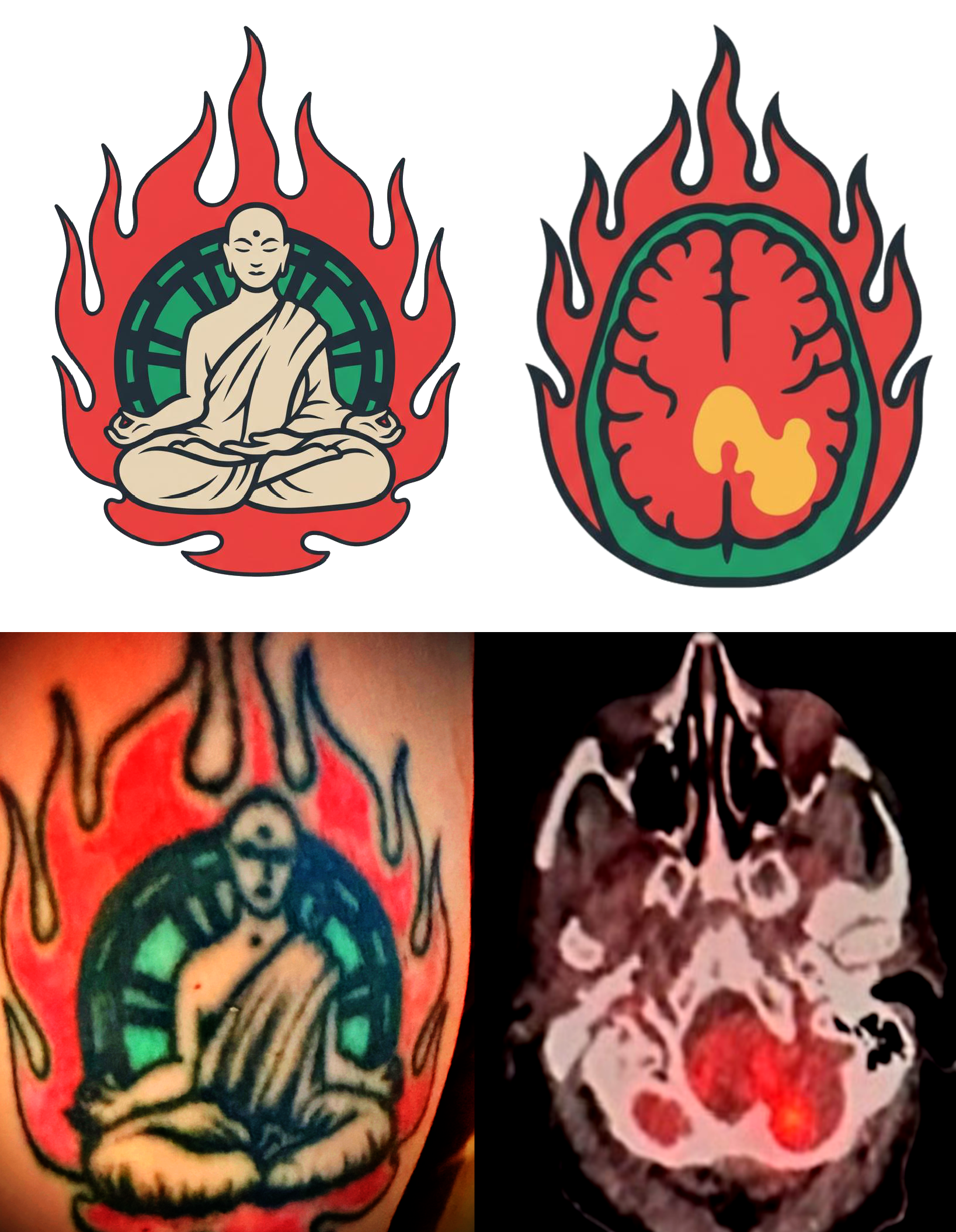
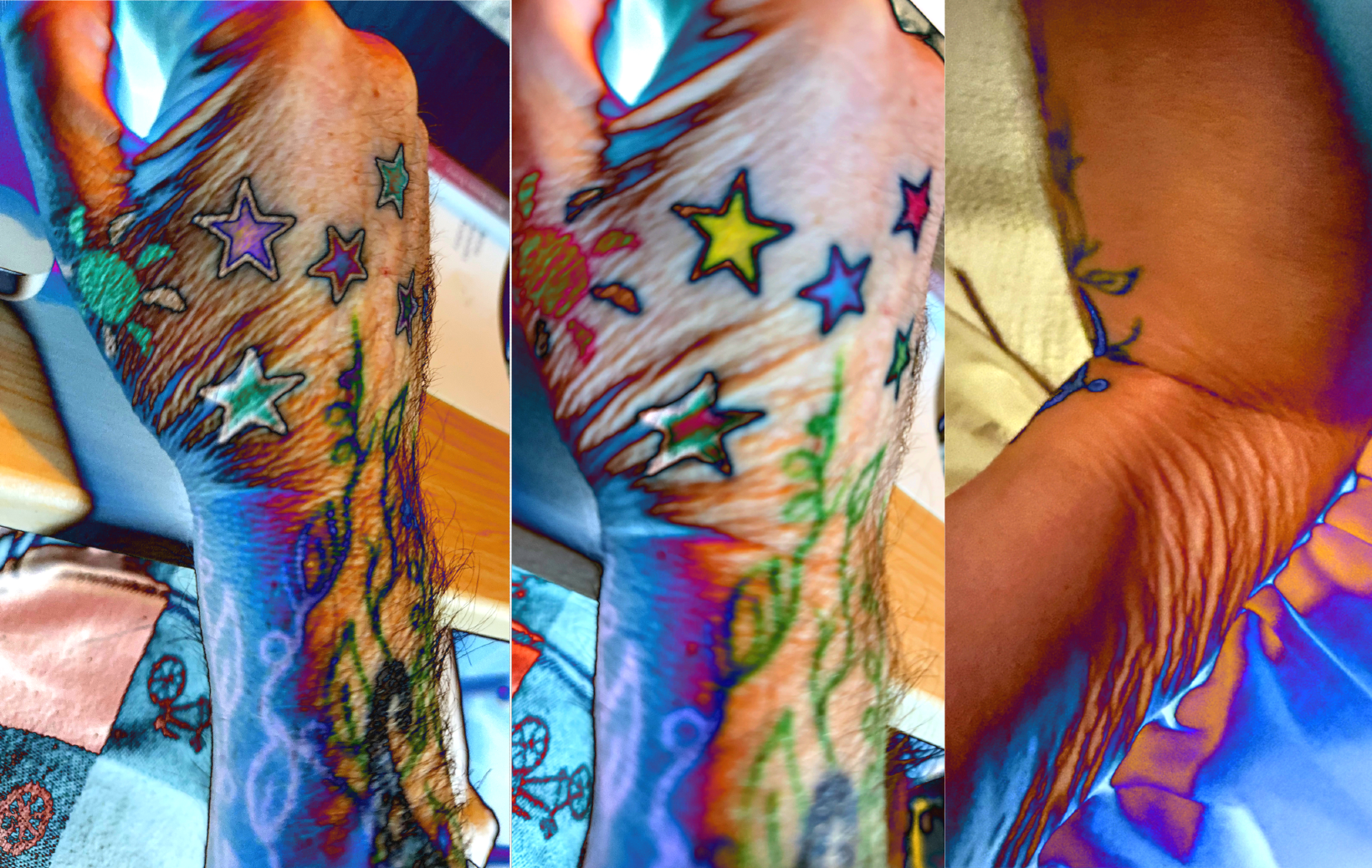
The moment I saw the very first scan the doctors showed me (bottom right, above: an MRI, rather than PET, as it happens)—on a small monitor wheeled into my cubicle at the Homerton—seemed to say everything at once. As I turned my head to look at the image of my brain on the monitor, I glimpsed also the tattoo on my left arm suddenly aligned with it (bottom left)—a tattoo of a bhikkhu meditating in flames, inked twenty years earlier, with the bhikkhu meditating as descibed in the Buddha’s Adittapariyaya Sutta (Fire Sermon)—such that the tattoo of the bhikkhu and the scan of the brain, aligned properly. One presaged the other by years, holding out its hand to the other. They reflected each other so neatly, with the tumour in the cerebellum showing up as the red-orange fire bursting through from within, which the bhikkhu sits through.
The wrinkled surface of the cerebral cortex in the scan echoed the Bhavachakra—the wheel of Saṃsāra, of cyclical existence (“Saṃsāra… is a Sanskrit word that means ‘wandering’ as well as ‘world’, wherein the term connotes ‘cyclic change’ or, less formally, ‘running around in circles’)10—against which the bhikkhu rests in the tattoo. Here is an image, not only of that empty time turning that we have talked of, of cyclical return and, dare I say it, reincarnation (though in this formulation, reincarnation is mere repetition, as in the ‘natural’ repetition of pagan society). In the original Fire Sermon, the argument is that the bhikkhu must free themself from the grasping tyranny of the senses. We, on the other hand, will be moving in the other direction. In any case, this combined image almost made me fall out of bed.

In much of what follows, I will mention coincidences, proto-visions, hints and signs of many things, hoping readers will put them together for themselves, quite apart from my prompting. But for the avoidance of doubt, I want to say openly now that what I found in all this is what Jeffrey Kripal has called ‘the flip’: “his term for the moment—through mystical or near-death experience…—when one decides that not only is all matter imbued with mind, but the idea that we are individual people is just an illusion: the entire universe itself comprises a single vast mind, through which our own apparently private consciousnesses are tiny cross-sections.”11 It is these cross-sections that have been crowding around me since C-day, piling up in front of me while calling out to one another unceasingly.

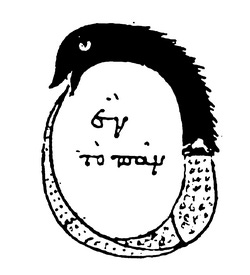
As such symbols echoed and returned in the days to come, they looked less like images of a pointless recycling, and more like promises of overcoming it, not just the a snake-tail swallowing and recycling of the Ouroboros reboot and Ragnarok (of which, more to come), and Nietzsche’s Eternal Return
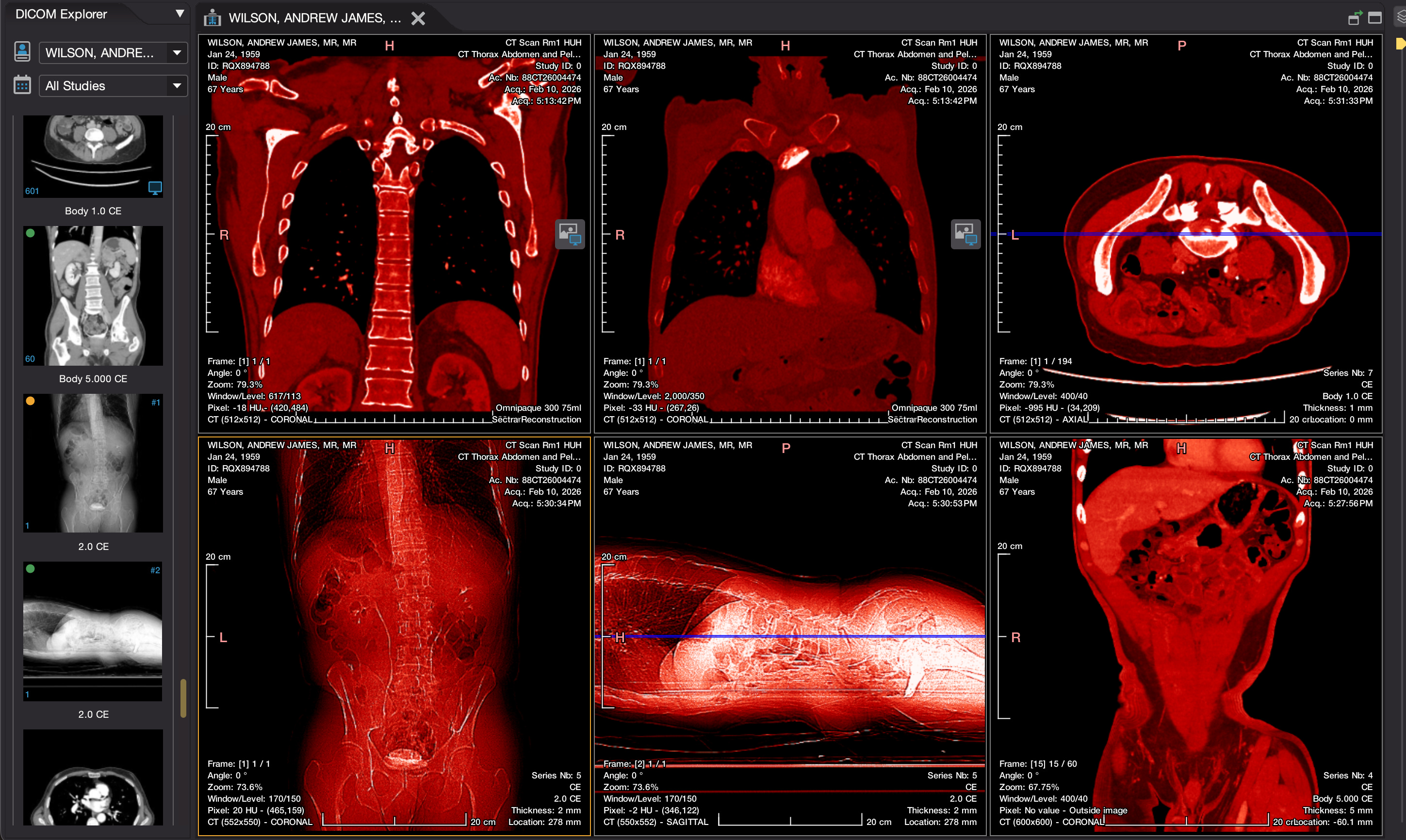
On seeing further scans, I recognised, eg., my rib cage as something indeed very much like the frame of Israel’s tents (above, top left), beaming on the shore of the infinite (Blake), but also, in the twisting images of the torso, I am struck by the sprawling energies at play, unleashed by disease. No longer is there the assumed underlying durable person, sealed away from the totality, cybernetically establishing their personal border by fending off and repurposing the chaos, sickness and disorder without. Instead, raw energies start to coalesce, turning Urizenic, mechanical rigidity into flashes, streaks and pulses of contending light.
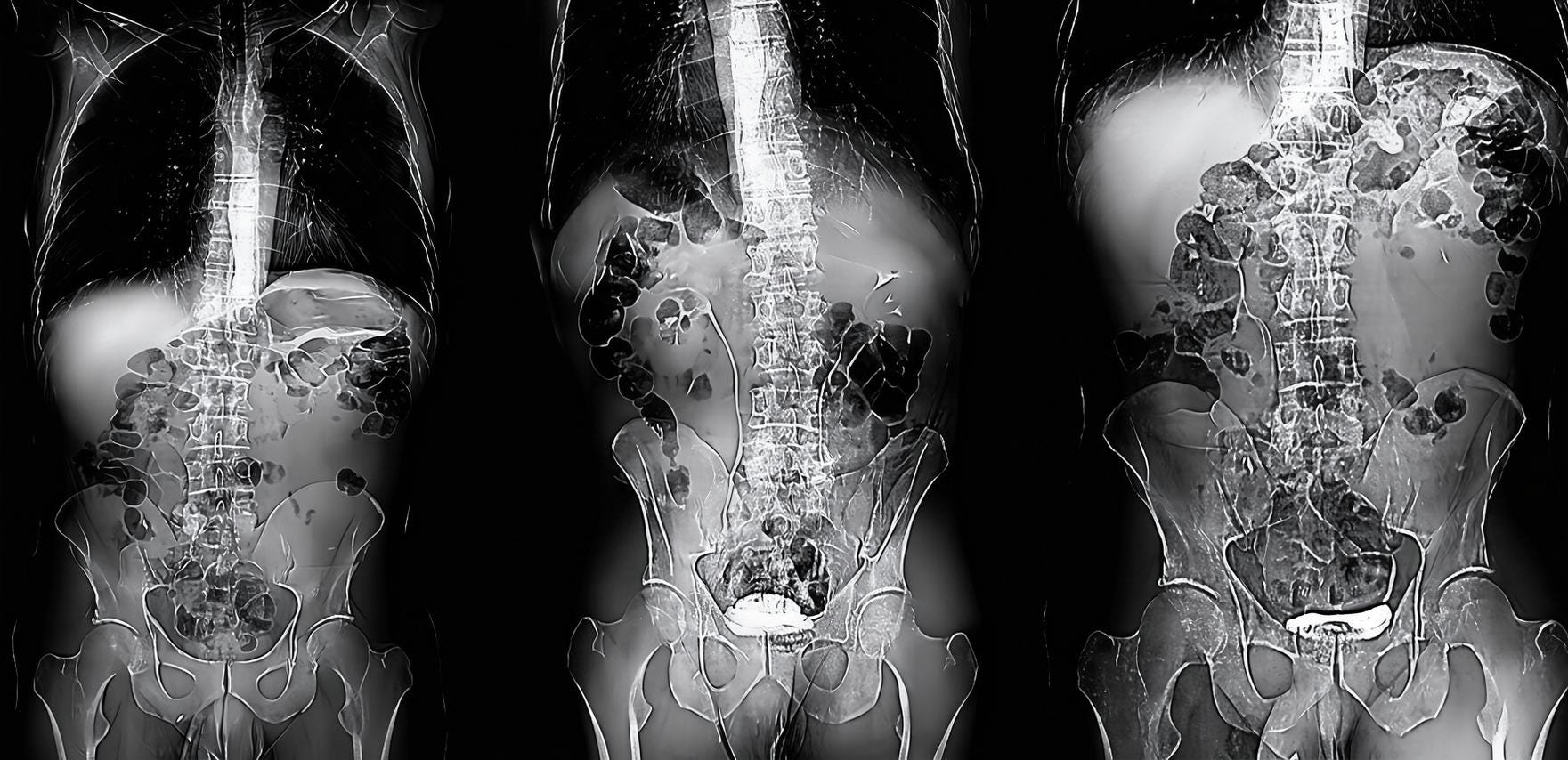
When looking at the flowing lights of the scans, I am not seeing the regular mechanics/dynamics of fluid flow and the like. It is not the competing power of the different forces involved, sloshing against one another, that impresses. That would represent a reasonable romantic regard for the power of things we don’t fully understand, and which we dimly suspect may outbid us in the end.
What I find more compelling in the forms on show are the signs of a deeper, primordial language of the cosmos, God’s being and the unconstrained underpinning of all those other things, the syntax of God’s mind and its reality of eternal esemplatic (form-giving, creative) inflation. To see the churning faces of the sea of light is to see the surface of the esemplasm that is all being, and which calls us from its depths.
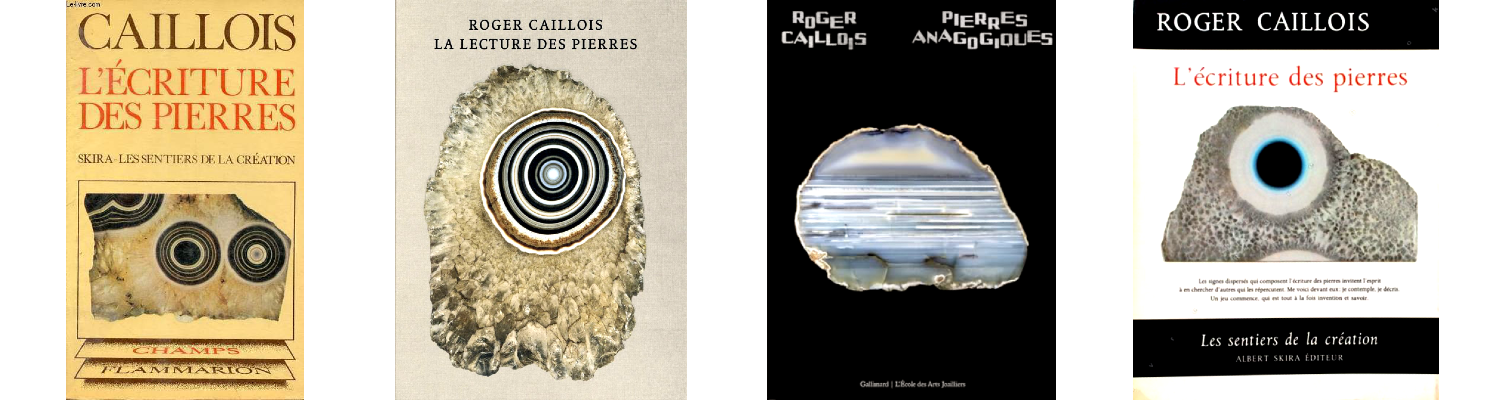
These dimly perceived logics, the raw shapes of the divine body of the imagination, are the subject of the dissident Surrealist, Roger Caillois’ 1970 study of stones, L’écriture des pierres.12
I see the origin of the irresistible attraction of metaphor and analogy, the explanation of our strange and permanent need to find similarities in things. I can scarcely refrain from suspecting some ancient, diffused magnetism; a call from the center of things; a dim, almost lost memory, or perhaps a presentiment, pointless in so puny a being, of a universal syntax.
Roger Caillois


I want friends to see that, as they enquire after my health as it relates to cells, seizures and toxins—and ‘anxiety’—they recall fears I hope to leave behind as fast as I can. Family want reconciliation and reassurance to steady their own wobbly ships, while you need to let go now of such wrappings.

But I don’t want to jump the gun, and the point is that the distinction, at first, only emerges and appears fitfully, blowing across the horizon. (“The wind bloweth where it listeth, and thou hearest the sound” John 3:08.) So let’s proceed slowly.

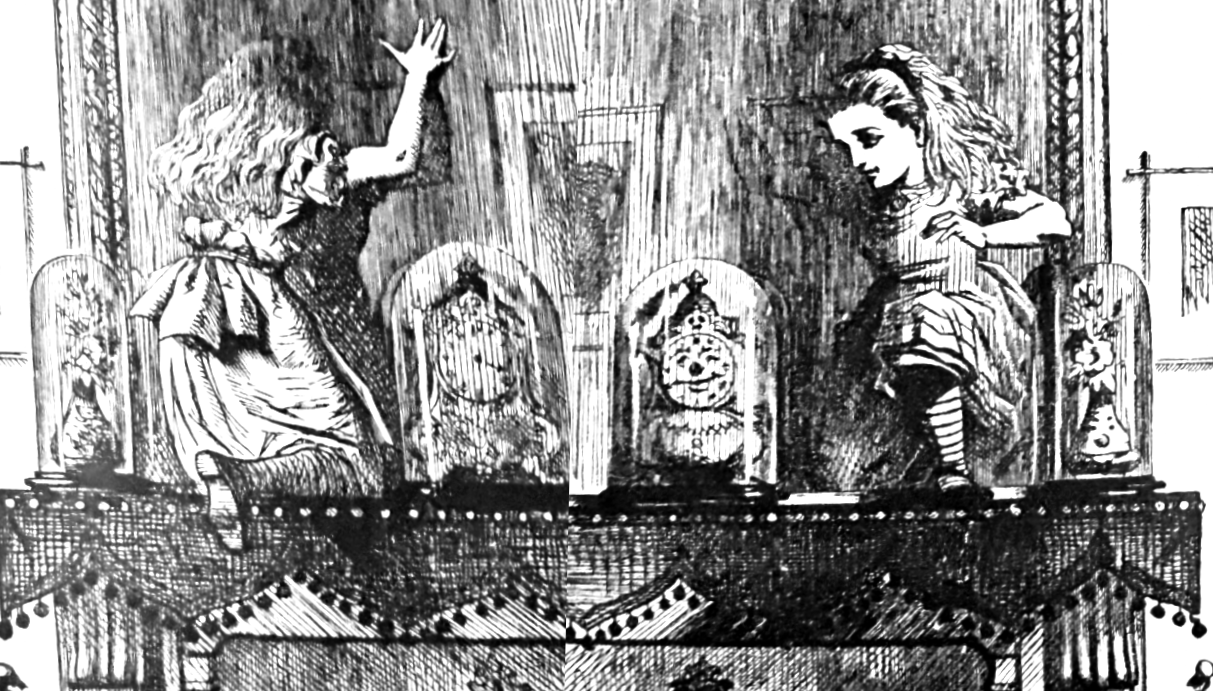
Wherever we find the flip between worlds, wherever we first pin it down, for me it was at around this point, a moment at which I knew for sure: “Time boom x De devil dead!” It is the moment when Alice, having fallen into one side of the mirror, plunges out into vistas on the other. Be aware that (as in Alice’s world), what follows will sometimes seem anachronistic, contrived, purple and awry when seen from the other perspective. But it is perfectly firm.

it’s probably what you already guessed. but it wasn’t
Days later, I received a call from the surgery. They’d like to discuss the scan results. Could I pop in… within the hour, perhaps? We are all suddenly alert and prompt. Time itself tightens. My wife comes with me, and soon we’re sat by the young doctor, who pulls out a sheaf of notes. “We’ve received the scan report, and I’m afraid it is what you probably already guessed.” It’s been several months, and I’d guessed nothing as yet. It seems that what they found in the first instance was a “left hilar mass highly suspicious for primary lung bronchogenic malignancy… encasing and attenuating the main pulmonary artery and upper and lower lobe bronchi.” That. Cancer. If you want to isolate the mic-drop moment, there it goes.
Shortly after this, I was moved to the Intensive Care Unit (ICU) at Homerton and the first phase of treatment started with new prescriptions to deal with various pa ins and to rein in any swelling of the cerebellum.

Only days after further tests have been collated and consulting conferences held, I‘m invited to Bart’s Hospital to meet the oncologist who will direct the next steps. All is confirmed about the spread of the tumour to the brain. The question is, has the tumour already spread too widely for me to benefit from whole brain radiotherapy? They will take a view.

Some days later, I am released back to my home, and an appointment is made with an oncologist at St Barts to summarise what has been learned to date and to start mapping out the beginning of treatment.


After an hour-long early morning meeting, I’m nervous but good to go. I find another plastic chair to park in; they tell me it will be at least two hours before there will be transport to get me home. After two and a half hours, maybe three, of trying to get to grips with Mrs Dalloway, a highly un-Bloomsbury-like driver manifests suddenly from out of the Bart’s car park and calls my name, along with that of another patient. Once in the car, he tells us we must detour East to pick up a third soul at Royal London, who also needs returning to Hackney.
At the Royal London, the driver pulls up sharply in front of the hospital entrance and dashes off to find his new charge. He also locks his two existing fares in the back of the car. The moment he’s gone, his car alarm erupts at full volume. We are locked in. Neither of us can reach the front of the car, nor do we know how to turn off the alarm.
I’m having a panic attack, not knowing how to get safe as the alarm screeches. The alarm stops; then starts again. It turns through three cycles before I can haul my legs and crutches by hand over and into the front seats, and, lying face down in the footwell, I manage to push open the driver’s door and flop onto the pavement.
Not paying enough attention to the instructions for my appointment, it’s now been eight hours since I’ve eaten (a bowl of porridge). I’d also forgotten to bring my medications as instructed and am aching all over. I’d been handed a terminal diagnosis (“I’m afraid no currently available curative procedures are appropriate”) and was still shaken by the alarm when I finally arrived home: shaken, yes, but oddly elated.

For all that, what I want to concentrate on is the gap between living and dying, persisting and passing. Perhaps I’ve already made too much of it, lending legitimacy to our fear of the modern ‘real’, turning it into a necessity to be ground through to the bitter end: “getting real”. But it is never that, which is always the point of Blake, right: did we forget? He is always available: the body of Christ, the esemplastic imagination. It just turns out that the prospect of death can open us up directly to this, through a “globule of man’s blood’” or many such globules together: scarlet rain.
For every Space larger than a red Globule of Mans blood.
Is visionary: and is created by the Hammer of Los
And every Space smaller than a Globule of Mans blood. opens
Into Eternity of which this vegetable Earth is but a shadow:
The red Globule is the unwearied Sun by Los created
To measure Time and Space to mortal Men. every morning.
William Blake, Milton13
According to psychologist Janis Chen, recent improvements and fine-tuning of targeted cancer therapy are conspiring to drag out the awful grinding struggle to exist indefinitely, post-diagnosis, creating a new breed of cancer sufferer, the ‘chronically terminal’. Oh, brave new world, that has such things as us in it!:
“In the UK, barely a decade ago, a stage four lung cancer diagnosis was a grim cliff edge… long-term survival remained in the single figures. Today, the momentum of clinical progress… has levelled that precipice into a vast, uncharted plateau... As a psychologist, I view this not just as a medical victory but as a profound existential shift: we have replaced the suddenness of the cliff with the tenuous permanence of the high ridge. Such a progression has inadvertently birthed a new demographic: the ‘chronically terminal’. We occupy an interstitial space.. still burdened with the responsibility of being within the world.“14
“Burdened with the responsibility of being in the world’: take that, loser. But we are not cursed this way; we are ‘Born to Go’, ready for grace, and we need to know how that feels. That’s where Blake comes in.
For He will command his angels concerning you to guard you in all your ways.
Psalm 91:11

And if that isn’t true, if all that is on offer is the machinic grind, how is it that today, of all days, I met an angel? That’s not something that happens, is it? Not ever. Not even becoming a ranting Christian aspiring prophet of considerable conviction could lead me to imagine the possibility of meeting an angel. But today, I did.


I‘d spent the morning in St Bart’s Basement Nuclear Medicine Centre, having more hot radioactive tracer poured in so they could test my kidney functions to see if I‘m fit enough for chemo down the line. Once again, I was warned not to sit near anyone on the bus on my way home. Utterly exhausted and aching all over, I set off. But after averaging less than one and a half hours of sleep a night this week, I probably wasn’t up for the long voyage. The bus stops I visited all seemed out of service, as I clanked from one to the next with my new walking stick rattling away.

It started to lightly drizzle out there, and I slipped over in the road by St Paul’s while trying to cross at the lights. Eventually, I caught a bus, but then, halfway home, the hospital called to pull me back in for a crucial vitamin B12 jab I’d forgotten, and I got off just before Hackney Rd to return, heading back west. Then, they called again to say I could perhaps leave it until Monday to return if that was easier. Once again, I turned about. A scooter, taking a corner too hastily, tipped me back through the doors of the store I was passing, onto the floor, just here.

It is safe to say that by the time I was back on my feet, I felt pretty sorry for myself. But then, just as I’ve passed where I worked near Hoxton Square a decade ago, someone shook me from behind. I must have seemed a sad sight when I turned toward him: teary and unshaven, tired and sorrowful.
The handsome young black man I saw beaming before me when I turned said, “Hey! you used to help me out all the time!!” Shamefully, confused, I answered, “I’m sorry, but I can’t even help myself today: I’m so fsckd.” To which he answered, “Nooooooo! Noo! No! Not that!!.. I just wanted to say I haven’t seen you for years, and you were always helping me back then! I‘ve missed you!” He beamed at me again. I lowered my head modestly. And then I lifted it again. And he was gone. Others passed by. I walked to the next stop.
Like Cleopas and friends meeting the resurrected Christ on the road to Emmaus,15 without recognising him for hours, it took the same time for recognition to dawn that evening as I was telling my friend, Tim, what happened. I suddenly saw an angel look in on me and smile. I did not know him at all. I met an angel. He put his hand on me this afternoon. It was as simple and direct as that, and if it doesn’t make sense, it’s for the same reason that Cleopas et al. struggled to make sense of their own absolutely indubitable experience.
The day I left has left an indelible mark on Andrew’s life—but that’s another story
At the heart of so much sudden, powerful vision was the quickening evaporation of trauma going on in the background to medical developments, trauma rooted in infancy, attached firmly ever since, dragging it everywhere behind me.
my big day out and what happened next
At the age of five, my family lived in King’s Lynn. My father drove a lorry for local transport firms—usually setting out from the docks there, a legacy of King’s Lynn having been part of the late medieval Hanseatic League, and thereby still a great distribution centre for goods shipping in from over the Channel.16 On this special day, greatly anticipated, my mother sent me packing with my dad for my first big day out on the lorry! This was an unprecedented treat for me, long promised.
We spent the day together in the cab, my father singing in his beautiful voice to the country hits of the day (he sang and yodelled magnificently in many country bands over the years). My favourite song from his repertoire ever since was Coventry’s Frank Ifield singing I Remember You, which I made my dad sing again and again that day. How did I know what came next?
When my life is through
And the angels ask me to recall
The thrill of it all
Then I will tell them I remember you
I can still see the inside of the cab. At one point, 62 years ago, I took my dad’s handkerchief and held it out of the cab window, feeling it flutter as the wind snatched at it, until it finally slipped down the road, disappearing forever in the rear-view mirror. My father was annoyed, but it passed, and we carried on singing.
What is remarkable is that these cab scenes are all I remember of the day, given what greeted us when we got home: my mother had eloped, taking brother, Phil, and the teenage lodger with her. It seems she had become pregnant by my father’s teenage cousin, Johnny Richardson, who’d been staying with us. He was sixteen or seventeen, a thief and a rent boy, and had a brutal childhood growing up in Seaham.
In her memoirs, addressed directly to me, my mother does not explain her attraction, only that she was bored with marital sex (“We were still on the twice-a-month routine”), and excited by the alternative (“It was only a matter of days before I became infatuated with little John. What he didn’t know about sex wasn’t worth knowing. I didn’t seduce him!”) Her frankness in these memoires to me is brave and quite amazing.

I have no recollection at all of the scene that greeted us at home when we returned. My only memory of the day, in summary, consists of a single life-long earworm of Ifield’s lyric, “I remember youuuu…” drawn out forever, while cutting back everything around it down to the bone. How can it be? Freud spoke of the ‘screen memories’ children have of innocent events, but which exist only to protect us from unbearable thoughts right next door, which we cannot face.17
I can’t tell you exactly how, but this day was certainly the foundation of much of what I did, said and felt for the rest of my life. Edith’s memoirs wryly comment, “The day I left has left an indelible mark on Andrew’s life—but that’s another story.” It is not a story she has chosen to tell. Instead, we had another story.

The only information I’ve ever been given about the scenes on the other side of my “remember youuu” loop-memory is my mother later telling me that, on seeing she’d gone, I announced to the world, “Well, good riddance to bad rubbish!”
How likely is it that a child would understand such an expression, let alone use it of their mother? And as she wasn’t there herself, this could only have been reported to her by my father, the only witness, who passes off his anger onto me instead, and for which my mother, while abandoning me, makes me responsible. I was Framed. Eventually, my father had me sent on to join Edith, John, Philip and (soon) Helen in Coventry. You’ve probably guessed it didn’t turn out well.

I won’t tell the details, spanning another decade and a half, but I’ll summarise it as a time in which John Richardson bullied and beat us. He raped, whipped, punched, humiliated and smashed other people and us too in endless permutations. He knocked out my front teeth by slamming my face repeatedly into the kitchen door one night as I tried to stop him from assaulting my mother (again). Mostly, he beat and humiliated my mother. He was a thief and ran a small, inept gang of other thieves.
He preyed on people wherever they existed to be preyed upon, and thought he could get away with it. He was not a clever man, but a wretch. I knew I was ’the better man’ from day one: though it didn’t pay to let him know that. Only recently, my mother confided that she suspected he may have been involved in the death of a young Czech woman in Coventry in the ‘60s, whose body was found the morning after he came home one night, seeming ‘very disturbed’. I could find no trace of such a murder anywhere in the press when she told me. She still speaks of him continually, given a suitable gap in the conversation.

After a decade of this, my mother obtained a court injunction against him, after which which he broke into the family’s refuge one evening when she was out, having left Philip to look after Helen and Jonathan, so she could have a rare evening with friends. John broke into the family’s safe house, holding Philip with a knife to his throat, telling him he would rape and murder his mother in front of him the moment she returned, and then kill the other children, too, and then him. In the end, he merely assaulted everyone and bolted.
The next afternoon, he abducted his Helen from her school gates and led the police on a weeks-long nationwide hunt to recover her: he “could not bear to see the glitter go out of her eyes at the prospect of living without him.” They were eventually found in a dilapidated caravan on the North East coast, where Helen had been locked in a divan for hours on end to keep her out of sight. I had just left home at this point, to join the Royal Navy.

Some years later, John would elope with one of Helen’s Coventry school friends, Sandra, have a daughter with her, and then, when that child was old enough, abduct her too and begin yet another police search, as he used his children to punish partners he otherwise could not control, as such powerfully toxic, risible men do. His ‘heartbreak’ made the news.
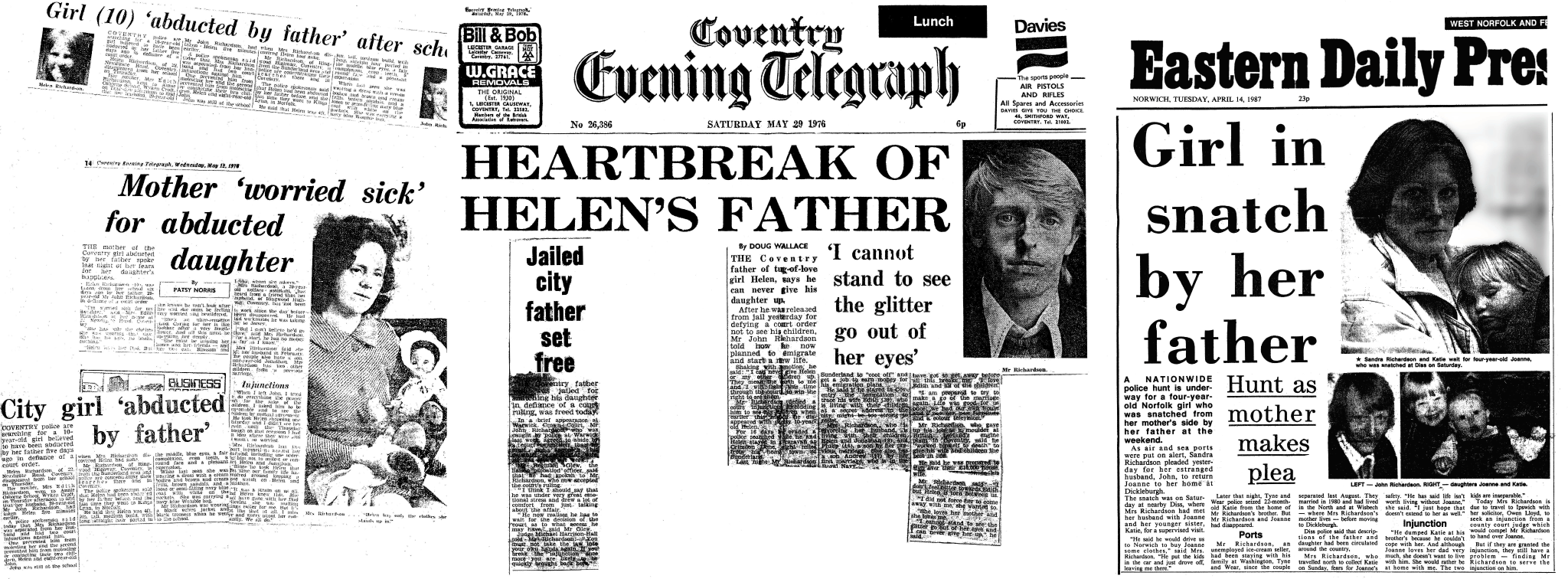
From the traditional point of view—quite correctly—the victims here are my mother and siblings together, and in our family history, the tale is one of his violence, browbeating and intimidation, and (unforgivable to her) his unwavering faithlessness in all things, not least towards her, physically and emotionally, with anyone willing and able, and how we suffered as a result, and how she fought like the tyger always to protect us.
While this is true, the family also ‘naturally’ broke down along different, divergent axes, forming complex alliances (‘multi-polar trauma bonding’), overlapping with the main narrative and just as likely to capsize and confuse it at points. Edith and Phil formed an unbreakable relationship in which she was the primary victim of the monster, the battered wife, but also the great other refuge for Philip and the children, under whom he sheltered for a lifetime.
Helen was moulded against all odds as a ‘daddy’s girl’ (don’t these men always). She clung to John as the one who could best defend her against himself, and she could rouse him to act against us instead of her if it helped shift his unwelcome attention away. Edith often boasts that she “never resorted to violence against the children”… but I know otherwise. Hundreds of events I recall are assigned to oblivion. And anyway, none of it would have happened if she hadn’t hauled off from King’s Lynn with John to begin with. Joanathan and I formed a solid bond that lasted. I was big brother, surrogate dad to my favourite toddler/comrade-in-arms, until we were both men and beyond. I believe I taught him to read when his school did not.
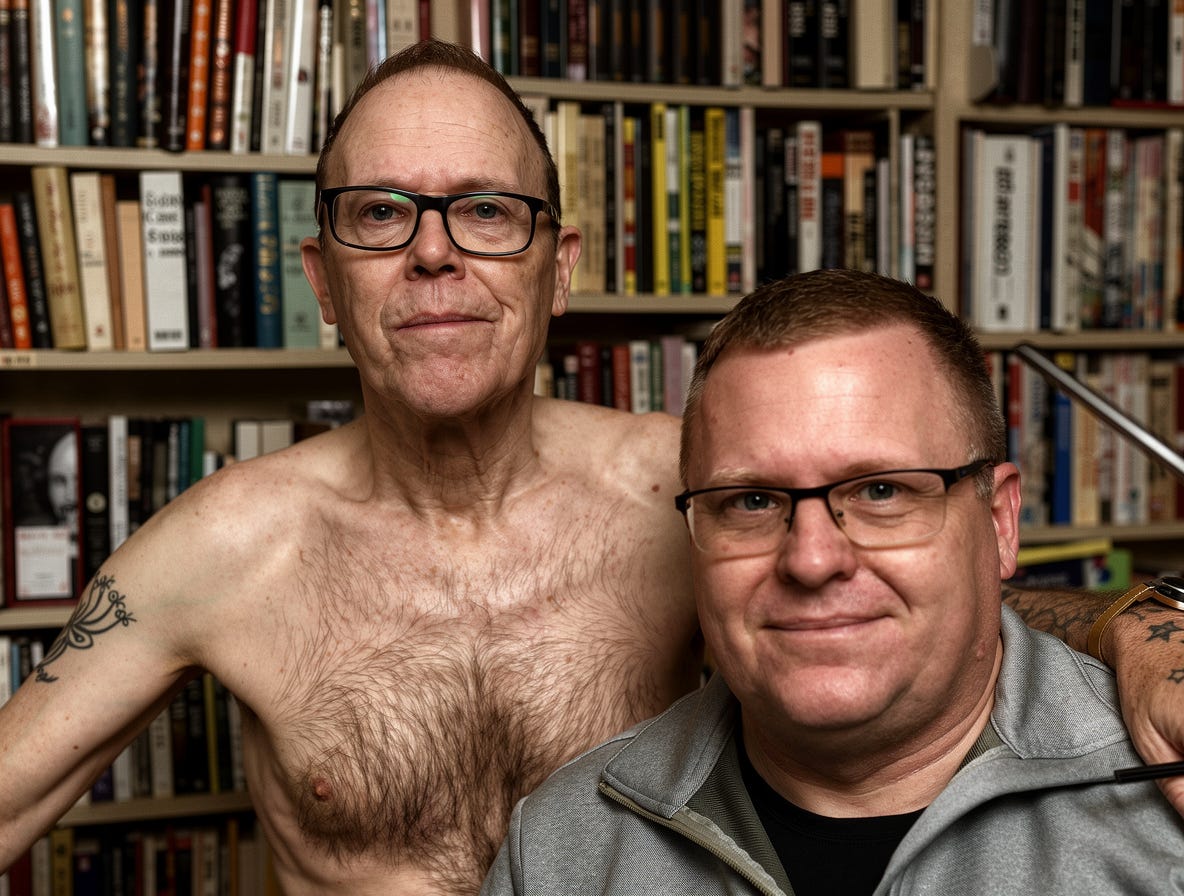
These multipolar relationships hide many things, but not least of all, at times, our own complicity in the trauma and the consequent guilt and resentments. The damage done commutes and lingers. Philip once drunkenly told me at length about how the day I left home was “the happiest day of his life”, which, given who he was sharing that home with [John], is quite an achievement. His first wife, on our first meeting, calmly informed me that I was “one of the most evil people who ever lived.” No details were forthcoming. I’ve spent a lifetime wondering what this was about and what I must have hidden from myself in the recesses of these years. However, if I mention this, I am a liar. We all love each other. I should try harder. “Philip loves you. Don’t lie.”
In fact, the very day I left home, I was abandoned again. Having packed the kit I needed for my trip to Torpoint, Devon and the Navy the day before departure, I returned to the family home to find Edith and the children (and the furniture) all gone. With Social Services' support, she had eloped again to escape John. All I could do was wait in the house for him to return from work and see what happened. He threw a pint of milk against the wall, but I was otherwise spared, albeit terrified that he might suddenly cut loose.
The following morning, I travelled to the station with a school friend, John Murphy, who waved me off forever. There wasn’t another family member in sight (they stayed away in case John followed me in order to catch them). My childhood was thus bookended by these two abandonments, leaving it wrapped in emptiness. This repetition forms the outer Ouroberos of my own life, just as the World Serpent , Jörmungandr, encircles the world, and the story I am telling here is of how I have now broken that circle: ‘amor fati’, no thanks.18

Why have I dragged this up? Because it no longer matters as much. I’m sorry to do so, but the ‘not mattering’ would be of little interest without some sense of the enormity of some of what happened. I’m sorry it still matters to my family, but I wanted to speak. I have the luck to see at this stage that the whole broken engine of these things has been nothing but a mill I no longer have to carry. It turns out I spent a lifetime trying to assuage perfectly recalcitrant people into accepting me, when they were incapable of it, through no fault of their own. And then I did it again. And again.
In that connection, I need to mention the wreckage of my mother’s own childhood, which prepared her for John. Born ‘illegitimate’, her father, a teenage Coventry boy, Jim Kennedy, died of TB weeks before the birth (as indeed, my grandmother, Margaret Alderson, died in the flu epidemic of 1936 giving birth to my father, and was buried in a pauper’s mass grave in Seaham), and she was entirely disowned by his family without further ado.
On her birth, Edith’s family took out an announcement in the Coventry Evening Telegraph so that polite society would know of these circumstances, because “we have to suffer the shame, why shouldn’t they?” Her mother, Florrie, also disowned her, and she was brought up by her grandparents as Florrie’s sister, until her friend, Olive Manning, blurted it out one day in the park: “I know something you don’t know: your sister is your mother!”
She desperately sought what she was not given by her family, but to get it she had to subdue a weak-willed, yodelling husband into marriage and cycles of humiliation. One Christmas, Florrie put the ashes from the grate into Edith’s Christmas stocking: the Norfolk manner of telling you you are unwanted. She wanted desperately to be loved. After John, she would remarry several times, elope from her third marriage with a charming scoundrel who immediately abandoned her, and then marry a Moroccan immigrant ten years younger than me, looking for love in Clapham. Finally, she moved back to King’s Lynn to retire in the very house where her grandmother raised her. She lives there still. Square One. I visit often.
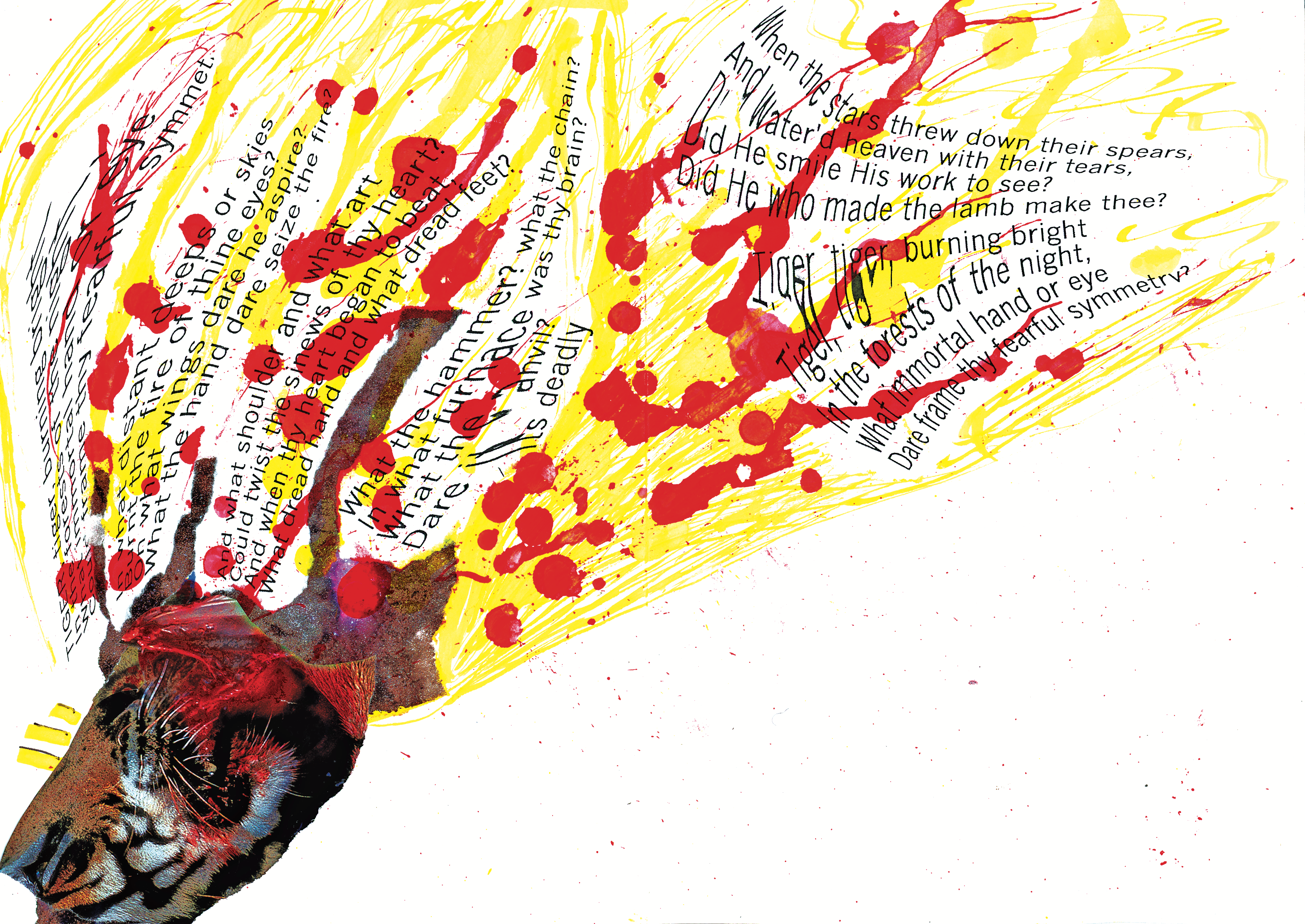
I should mention that, in the 1980s, not long after all this happened, brother Philip recorded some wonderful songs about these times for his indie band, The June Brides. I will only mention the song, No Place Called Home. There were many more:
I want something that I can hold,
I want my life, at my control.
A rock to stand on, to keep me whole,
But each time it slips away, the cause unknown.
In all the places I have lived, I’ve never been at home.
The June Brides, No Place Called Home19

home.Click to play.Forgetfulness dumbness necessity in chains of the mind lockd up
In fetters of ice shrinking. disorganizd rent from Eternity
Los beat on his fetters & heated his furnaces
And pourd iron sodor & sodor of brass
Restless the immortal inchaind heaving dolorous
Anguished unbearable till a roof shaggy wild inclosd
In an orb his fountain of thought
William Blake, Vala: Night the Fourth
heaving dolorous
his fountain of thought
Just as Blake in Vala describes the eruption of man-as-such into bodily form, the Genesis of ‘man’, descending into the world of shadows, this itself is also a description, not only of Adam-at-large, but the acquisition of the particular labyrinthine forms of the particular mind, your own peculiar ‘fountain of thought’. It was on this unremembered day that I really blew into existence in the peculiar way I would come to exist. It's good finally to sense the prospect of sliding down from this life-long erupting ‘fountain of thought’ to come home.

vasospasms of the great masturbator: bad brains
I have cheated a little by not explaining perhaps just how well I might have already been prepared for death by experiencing its touch before. As a child, I was terrified of death as the thought of an infinite constriction or claustrophobia, with my end closing in relentlessly. I could have a panic attack just thinking of it.
A brush with death in 2005 changed that. The circumstances in which the centre of my brain (a 3/4” diameter aneurysm, situated ‘sub-arachnoid’—yes! beneath the spider’s web that surrounds and snares the brain—in the `Circle of Willis’) detonated early one morning have just been narrated by me for my friend, Maco Maurizi’s newly released concept album, ‘The Life and Death of Wilhelm Reich’, which riffs on sexual repression and death together.

In this track, recorded like one of Zappa’s paranoid sociological enquiries under the studio piano frame, in 200 Motels, Civilization Phaze III and elsewhere, I raise the question of whether masturbation unto to death can ever be justified. You might want to play this now to hear how this came about, so I can get on with explaining how the outcome upended my fear of mortality forever. You may also want to download the artwork and libretto.


On being rushed to the Royal London for an operation to seal the aneurysm with platinum coils, it seems that the moment the equipment entered my brain (inserted by way of the veins in the leg, with a camera threading the coils, winding its way through your heart before landing at the center of the brain to do its job: a “GDC coiling of anterior communicating artery aneurysm”), my brain simply shut down in a vasospasm, cutting off the blood to the brain. The operation was stopped immediately, and I was returned to the Intensive Care Unit, where my family was told to expect my death at any moment, or, short of that, for me to emerge as paraplegic.
This did not happen. I recall emerging into consciousness again 24 hours later, and a doctor asking me if I knew where I was and who the British Prime Minister was. I told him I was in The Royal London’s ICU, that the Prime Minister was Tony Blair, and that I had some thoughts about his leadership, if anyone cared to hear them. I was alive.


They could not repeat the operation immediately, but only give it a few days to see if the rest would incline the brain to be more cooperative in a second attempt. At the same time, with the aneurysm gaping open, potentially leaking blood into the brain at high pressure, they couldn’t wait much longer. As I was taken down on the trolley early one morning, three days later, for the rematch, when they injected the general anaesthetic and invited me to count down from ten, everyone, including myself, knew these may be my last moments. I experienced a deep sense of contentment, happy with my life. I got to hear John Coltrane and Sun Ra in this life, and swooned happily into unconsciousness. Twelve hours later, I reemerged on the other side, the aneurysm sealed.


I have long considered this the greatest blessing of my life, removing once and for all an ancient fear. A decade later, I learned while training as a death doula that such attitudes at the door to death are far from the exception; it is just that the culture’s egoic obsession, and the fetish of the wholly differentiated mind, set apart from the world, spark panic at the thought of being separated forever. You were never alone in this way, and you never will be. Fellow traveller—bear up.
mumufication, Kali’s ponderable black holes and your fortunate spaghettification
She is the womb that births all, and the tomb that swallows all.
Aditi Devi20
My interest in death now fully awakened after the coiling party, I set out to study as a death doula. According to the End of Life Doula UK body, “an end of life doula is a compassionate, trained companion who supports individuals with a terminal diagnosis and those important to them. Offering support at any age or stage of illness, our non-medical role is to preserve the quality of wellbeing, sense of identity and self-worth from the moment we are called upon”21


My interest in the cultural aspects of dying eventually led me to sign up for Mumufication, and incorporation in the People’s Pyramid at an annual counter-cultural event in Liverpool, hosted by Bill Drummond and the KLF. Twenty-three grams of your ashes are kiln-fired into a brick, which is added ot the base of the pyramid, one for every mumufication volunteer, each year.
Just as impressive to me was my discovery of the deep analogies between Kali as a goddess and the process by which she annihilates her victims in death by tearing away their ego structures, allowing them to disintegrate into the mind-lake. I won’t state the whole argument, but I encourage you to read it separately.
Kali, Chaos Magic and the KLF: On Black Holes and the Rites of Mumufication

Kali’s protruding tongue expresses her contempt for her followers, and the illusory persona they have adopted in order to live in society. Kali sees through you. As death / Kali approaches, her weapons hack away at the illusions that constitute the ego and enforce social propriety, just as in life, the dying person must abandon their illusions about themselves as they have lived their life in order to affirm a deeper reality. Our illusions and attachments are burned away as death approaches, just as all matter is hopelessly torn apart (‘spaghettified’) as it approaches the event horizon of the black hole. All will be consumed and nullified by the black hole, including time, but not until its illusory appearance in this world, within time, has been torn to pieces. Such a shredding of illusions is also what is taught in the Tibetan Book of the Dead (Bardo Thodol), in which the dying person must let go entirely of their attachment to (the illusion of) the self…
You can download the talk as a [PDF]

concluding post-scientific prescripts
on the haunted shoreline
In thinking through aspects of reincarnation in recent days, I am beholden above all to fellow Faust fan Nick, author of the Surrealist blog, The Haunted Shoreline, where he excavates alchemical and other mysteries on his walks along the Lewes coast.
On hearing news of my illness on the Faust gravevine,22 he set out for the beach with his partner, Anastasia, to look for a sign for me. In his own words: “After a while on the beach, Anastasia... was coming the other way… with something in her hand... She handed me the small stone globe of the fossilised sea urchin. We both knew its significance, as I had previously written about a similar fossil, exploring its historic symbolism as ‘the egg of the World Serpent’ and its association with the idea of resurrection.”
‘This symbol enshrines ideas of motion, continuity, self-fertilisation, and, consequently, of the eternal homecoming… Another interpretation may see in the Ouroboros the contrast between two planes of being. The serpent biting its tail falls into the shape of a circle, a break with its linear development which would seem to be as big a change as emergence upon a higher level of consciousness.” (Jean Chevalier and Alain Gheerbrant)23
But Nietzsche is being trumped here in the fossil, for while the urchin as snake represents the circularity of pagan time, the fossil sea urchin not only represents this Ouroboros, but overcomes it and raises it to the next level, mostly by virtue of how the symbolism morphed anyway with the adoption of Christian culture in the pagan heartlands. Note that Anastasia is a feminine given name of Greek and Slavic origin, derived from the Greek word anástasis, meaning ’resurrection’ or ‘rebirth’, often associated with strength and the concept of returning to life.
On finding the fossil, Nick booked a ticket to see me in Hackney with his gift, which I have right by me now in pride of place on the desk here. Nick added before leaving, “yours is flint, rather than chalk, which seems apt.”


scarlet rain falling: libelling the dead


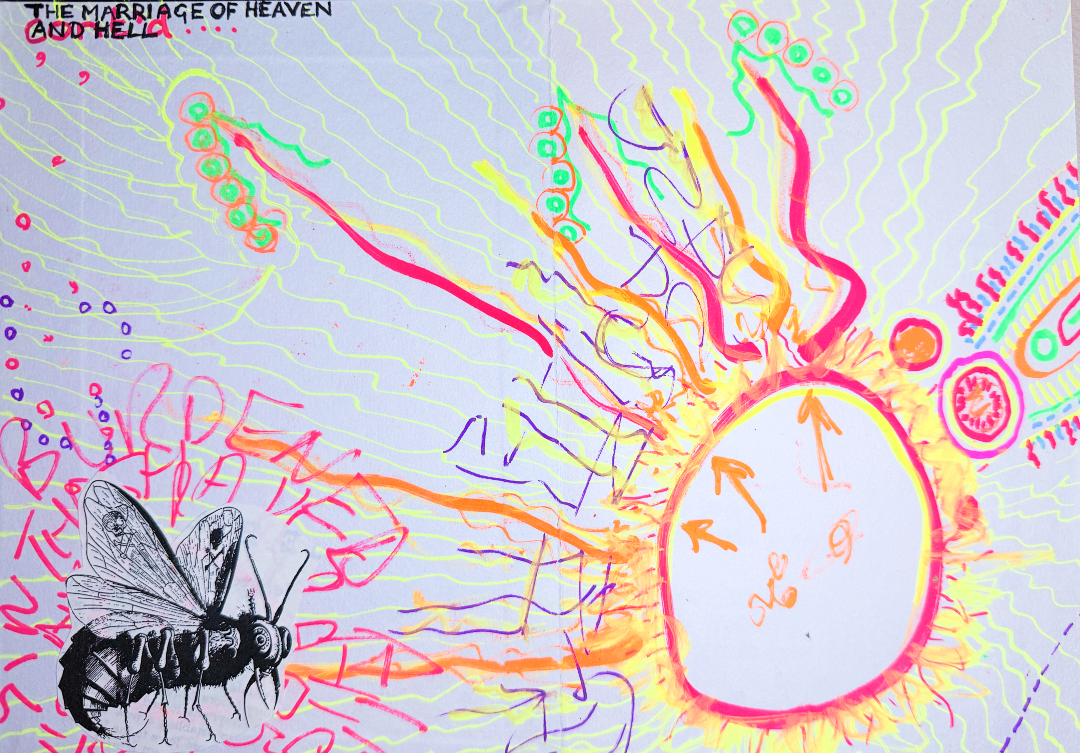
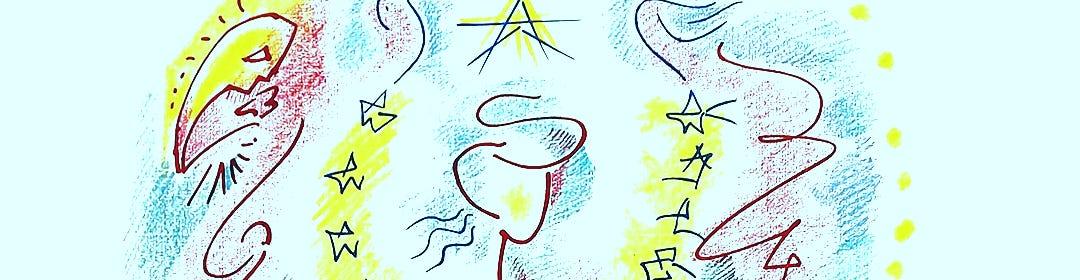
In looking at the scan images in this post, try to imagine just how surprised I have been to realise that some 2-3 years ago I started working on a long (for me) poem/collage construction, which, for reasons I cannot explain (are there ever any such tidy reasons), I called Scarlet Rain. I have worked on it patiently for some time now.
The techniques used in construction were chosen to be slow and laborious, as I wanted to harness the meditative energy I find in such work, allowing me to incubate ideas and intuitions I am not even aware of as I write or design, drawing on unconscious motivation as best I can, as I tried to explain in a talk to the Blake for Artists group about the fitful creation of my fanzine Blake reader, The Brilliant New Hercules.
You will see from the examples above that I am soon talking of lungs and jaws, ‘Easington irradiation’, blooming bones and the ‘undead bloodsuck’. The work currently stands at more than seventy pages, but remains unfinished. It includes many vignettes and side glances at my family history, as well as thoughts on ‘libelling the dead’.
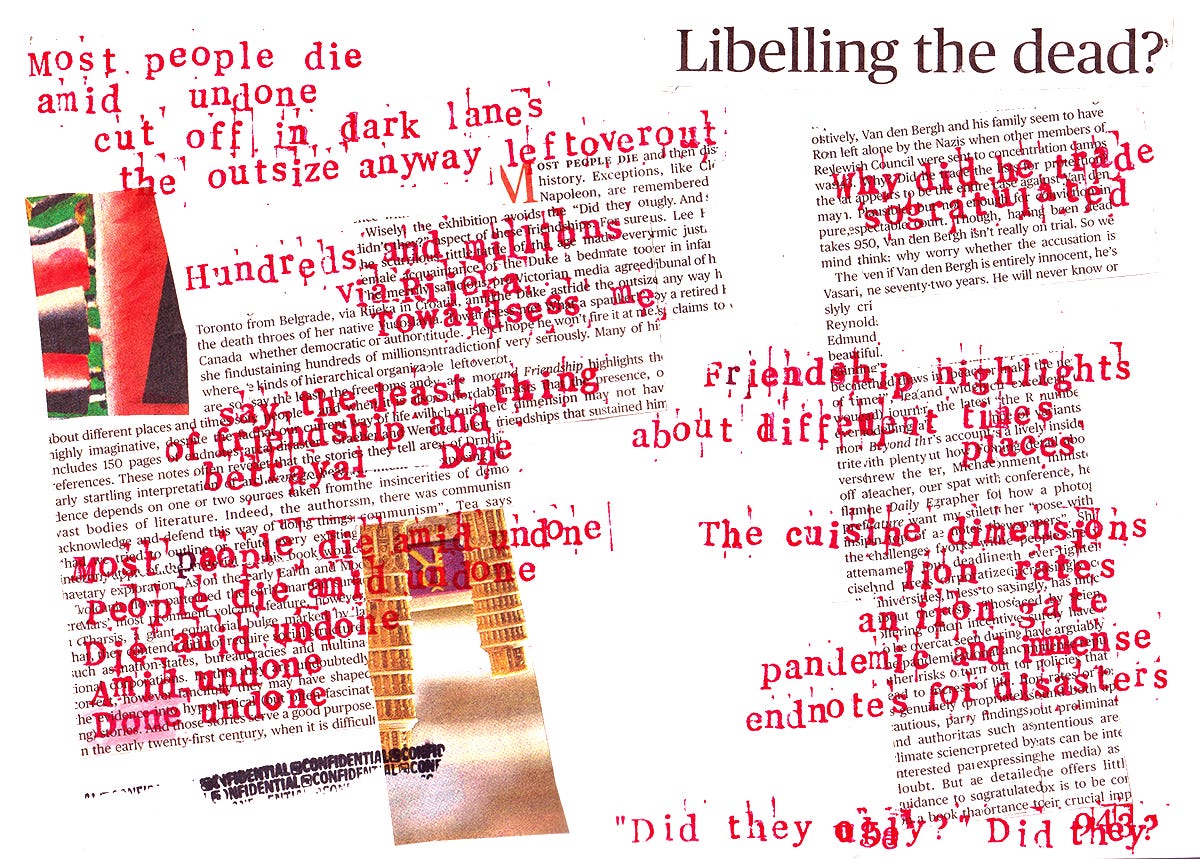

Finally, for now, a careful reader will have spotted that there is at least one area of life where I have continued to grind away: in writing this blog post. Whenever I haven’t been in pain, in transit, or swimming in morphine over the last few weeks, I‘ve been trying to capture these thoughts in the hope that they will be of interest to those who have followed the drift of the Traveller from the beginning. With the time remaining, I hope to say more.
Consider subscribing to stay informed. Please take out a paid subscription if you can afford it
Life’s a long song
If you wait then your plate I will fill
Ian Anderson



As the Trianon commentary notes of this plate, pl 14, of the Traveller in motion: “The enlightened man now hurries to meet the immortality he has learnt to expect.” Geoffrey Keynes, William Blake’s The Gates of Paradise: For Children • For the Sexes: Introductory Volume, with Blake’s preliminary sketches, published by The Trianon Press, for the William Blake Trust, London, 1968. William Blake, ‘The Traveller Hasteth in the Evening’, For Children: The Gates of Paradise, 1793.
George Richmond, letter to Samuel Palmer, August 15th 1827.
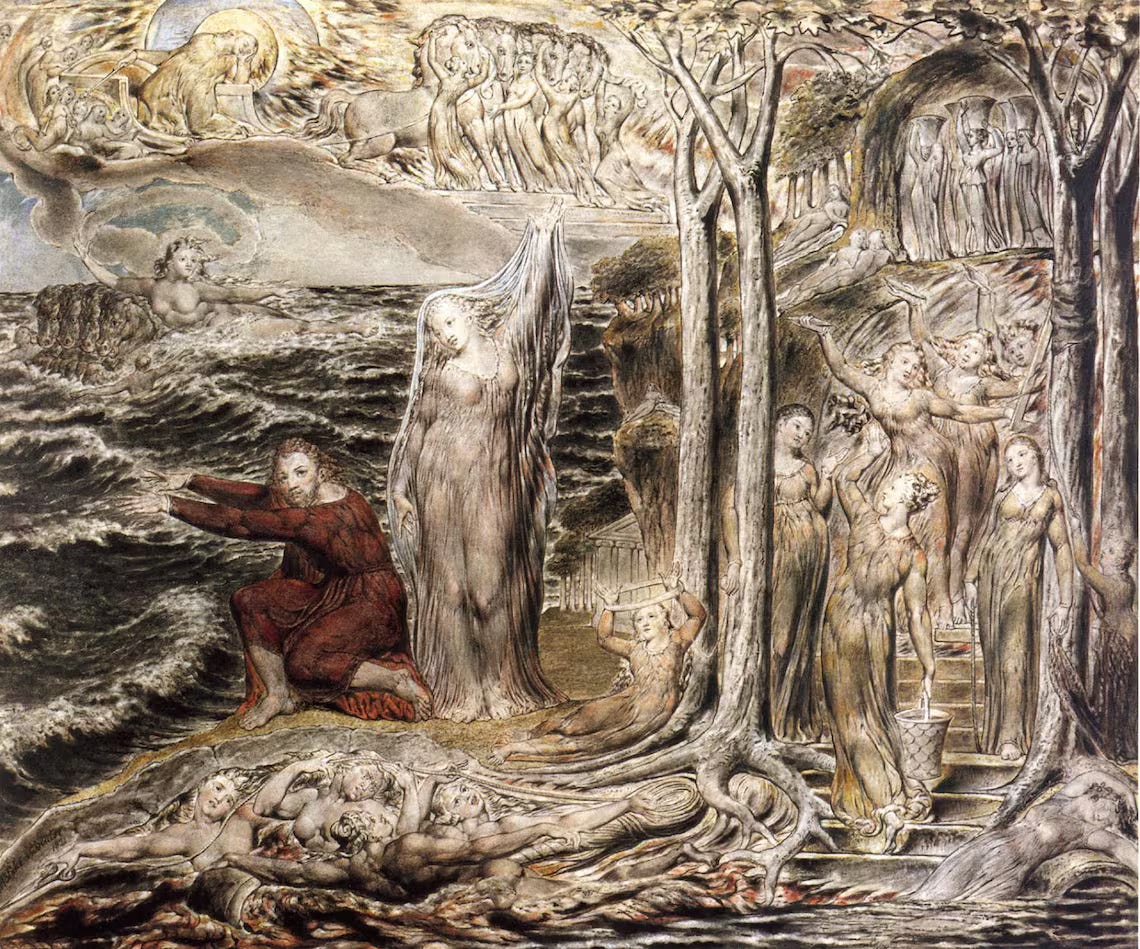
“Blake sent a letter to Ozias Humphry, dated 18 Jan 1808, describing this design in some detail. Blake included another copy of the description to forward to the Countess of Egremont, who had commissioned the work. Humphry had played a role in obtaining the commission for Blake. At Humphry’s request, Blake sent yet a third version of his Last Judgment description to Humphry, for forwarding to the Earl of Buchan, with a covering letter dated Feb. 1808. For a composite text of these Last Judgment descriptions, see Erdman pages 552-54. For a text that records the variants among the three versions, see Bentley, Writings, vol. 2, pages 1637-41.” The William Blake Archive, blakearchive.org, accessed 2026-03-26. Note that the image linked inline in the text above is reworked and recoloured by myself, anticipating the ‘paint in light’ imagery later in the text. For Blake’s original design, follow the link above.
Gillian Rose, Madeleine Pulman-Jones (Introduction), Love’s Work, London: Penguin 1995.
“The most direct translation of the term ‘metanoia’ from the Greek to English is ‘think again’.“ ‘Metanoia (theology)’, Wikipedia, wikipedia.org, accessed 2026-04-02.
Sri Krishnaprem said “My ship is sailing” before passing away. In some schools of Vaishnavism, life is depicted as a tumultuous ocean, and Krishna as an ‘unsinkable ship’ or boat that carries devotees across the sea of material existence to safety. ”My boat is sailing on the shore of Shri Krishna”.
The link here is to a recording of Eugene Chadbourne made at the Cafe Oto, London, when he appeared solo there in April 2014. Eugene stayed at my house, and I recorded him singing this Johnny Cash song about Vietnam. The song has no direct relation to the story of my leg tumour, but invokes family ghosts anyway, of those who perhaps ”love us, but they don’t understand.”
A few years ago, this procedure would take up an hour or so of your time, as you were prepped in a side room in the Day Stay Unit before being wheeled into theatre for examination. Recently, the experience has been downsampled into a quick-fire queue of men, from each of whom a urine sample is wrung before being shunted into a side room in the Outpatients Reception, where they drop their trousers and hop on the table for a quick turnaround. Ten minutes later, you are on the bus heading back home, sore.
William Blake, ‘Mock on Mock on Voltaire Rousseau’, The Pickering Manuscripts (1803), Erdman (1988), [E478].
‘Saṃsāra‘, Wikipedia, wikipedia.org, accessed 2026-04-02.
“This idea, too, has a long history, being essentially the view of the 17th-century philosopher Baruch Spinoza. But how seriously should we take it? Nothing in science rules it out, Kripal argues, and indeed Einstein’s “block universe” model of space-time, according to which the past and future are just as real as the present, can be taken to imply it. Just as interesting is what would follow about human society if everyone came to believe in the idea. As Kripal points out, racism, nationalism, prejudice, and arguments over identity or faith would be plainly absurd. “Herein lies the potential politics of the flip,” he writes. “We are not our thoughts. We are not even our beliefs. We are first and foremost conscious and cosmic, which is to say we are human.” Steven Poole, ‘The Flip by Jeffrey J Kripal review—it’s time for a mystical revelation’, The Guardian, theguardian.com, 2020-04-29, accessed 2026-04-01.
Pierre Caillois, Marguerite Yourcenar (Introduction), Barbara Bray (Translation), L’écriture des pierres / The Writing of Stones (1970), Charlottesville: University Press of Virginia, 1985. The French edition is magnificent, with hundreds of full-face plates of stones from the Caillois collection: Roger Caillois, Massimiliano Gioni (Preface), François Farges (Photography), Henri-Jean Schubnel (Texts), Gian Carlo Parodi, La lecture des pierres: pierres l’écriture des pierres agates paradoxales, Muséum national d’Histoire naturelle.
“The years before the war were marked by Caillois’ increasingly leftist political commitment, particularly in his fight against fascism. He was also engaged in Paris’ avant-garde intellectual life. With Georges Bataille, he founded the College of Sociology, a group of intellectuals who lectured regularly to one another. Formed partly as a reaction to the Surrealist movement that was dominant in the 1920s, the college sought to move away from surrealism’s focus on the fantasy life of an individual’s unconscious and focus instead more on the power of ritual and other aspects of communal life. Caillois’ background in anthropology and sociology, and particularly his interest in the sacred, exemplified this approach.” ‘Roger Caillois’, Wikipedia, wikipedia.org, accessed 2026-04-02.
Janis Chen, ‘I have stage four cancer – there will be no cure, but death isn’t necessarily imminent: this is how it feels to live in the long middle’, The Guardian, theguardian.com, 2026-03-22, accessed 2026-03-22.
“This occurs three days after the crucifixion, on the same day as the Resurrection of Jesus. The two travellers have heard that the tomb of Jesus was found empty earlier that day, but have not yet believed the women’s testimony. They are discussing the events of the past few days when a stranger asks what they are talking about. “Their eyes were kept from recognising him.” He rebukes them for their unbelief and offers them an interpretation of scriptural prophecies concerning the Messiah. They ask the stranger to join them for the evening meal. When he breaks the bread, “their eyes were opened”, and they recognise him as the resurrected Jesus. Jesus immediately vanishes.“ ‘Cleopas’, Wikipedia, wikipedia.com, accessed 2026-04-01.
King’s Lynn was Great Britain’s first member of the Hanse (The Modern Hanse League). Beverley, Boston, Great Yarmouth, Hull and Ipswich are currently the only other members from the United Kingdom. The Hanse is an active network of towns and cities across Europe, which historically belonged to the association of merchant towns known as the Hanseatic League. The original medieval Hanseatic League, which comprised a group of towns around the Baltic and the North Sea, was an extremely influential trading association and was very much a part of King’s Lynn’s development and historic past.“ Dr Paul Richards, ‘Hanseatic King’s Lynn’, visitwestnorfolk.com, accessed 2026-03-29.
“We hear that there are some people whose earliest recollections of childhood are concerned with everyday and indifferent events which could not produce any emotional effect even in children, but which are recollected (too clearly, one is inclined to say) in every detail, while approximately contemporary events, even if, on the evidence of their parents, they moved them intensely at the time, have not been retained in their memory… In my experience, based for the most part, it is true, on neurotics, they are quite frequent. … We must first enquire why it should be that precisely what is important is suppressed and what is indifferent retained; and we shall not find an explanation of this until we have investigated the mechanism of these processes more deeply. Sigmund Freud, ‘Screen Memories’, Studies on Hysteria, lutecium.org, 1899, accessed 2026-03-30.
“Amor fati is a Latin phrase that may be translated as ‘love of fate‘ or ‘love of one’s fate’. It is used to describe an attitude in which one sees everything that happens in one’s life, including suffering and loss, as good or, at the very least, necessary. Amor fati is often associated with what Friedrich Nietzsche called “eternal recurrence“, the idea that everything recurs infinitely over an infinite period of time. From this, he developed a desire to be willing to live exactly the same life over and over for all eternity (”...long for nothing more fervently than this ultimate eternal confirmation and seal”). ‘Amor fati’, Wikipedia, wikipedia.org, accessed 2025-04-01.
Phil Wilson, The June Brides, No Place Called Home, InTape Records, SN-ITTI024, 1985.
William Blake, Vala, or The Four Zoas: Night the Fourth p54:4-10, Erdman (1988), [E336].
Recorded for Marco Maurizi’s album, The Life and Death of Wilhelm Reich, I related the background to the brain haemorrhages that produced my first profound brush with death. The pretext of the experience—masturbation causing the explosion of a (borderline—3/4”) giant aneurysm, was the everyday underpinning of something marvellous in itself that you would not detect in the events as related. You can find the LP notes and libretto here and listen to the music here.
Andy: “I was thinking about how, you know, wanking can lead straight to death. Or, yeah, most of the way. You know, that happens: my girlfriend was away. And I ‘found myself’ having a wank. And then, all of a sudden, there was like I’d been hit in the face by a hammer. And I had a fit and started being sick everywhere.
And then I don’t know what happened for a while, but when I came around, I had incredible pain in my head. It was early in the morning and I had to wait for half an hour to walk up to the doctor’s surgery. I couldn’t see much because the light was so blinding (photophobia). I got to the surgery and told them I’d had a brain haemorrhage. The doctor wasn’t convinced at all. She was tapping me on the knees and elbows with a little rubber mallet. And she said everything is working, “you probably just caught some infection”. I was in agony. I could hardly open my eyes at all. But she wouldn’t have it.
I said to her—because I think if you’ve got a philosophy degree it’s important to tell people about it—I said to her, I’ve read philosophy and philosophy of science, and they say that for any situation, there’s a test that shows either way what is the case (positivism). I said, are we doing the right test here, banging away at my elbows? And she said that the right test is to look into the eye, where the optic nerve enters the eye:, if that’s distended, then you’ve had a brain haemorrhage. So I said, ”so why don’t we do that test?”
She looked in my eye, and I remember she said, “OOH!!” Because it was really distended. I was now banging the table, ”That’s it, I’ve had a brain haemorrhage!” But she still wouldn’t have it. And she phoned a consultant up and came back and said, no, it can’t be it” So she sent me away.
I spent a week with a woolly hat on with ice packs underneath, lying on the couch all week with the ice packs on my head.
The funny thing about the story is that, exactly one week later, my girlfriend was away again. She was going to some training at the same time each week. You’ll never guess what I did. And the same thing happened. I had another brain haemorrhage and another fit. It was the worst pain I’d ever had. Worse than the week before. But I got to the doctors, I almost crawled there. And she still wasn’t having it. Finally, she conceded that she would send me to the Homerton Hospital, but she wouldn’t call an ambulance.
So I got a taxi. Went to Homerton. They did a CAT scan and then they just set alarm bells going off everywhere. I mean, literally: alarms. They immediately sent me by ambulance to the Royal London Hospital, a few miles away.
They operated on my brain a few hours later. The funny thing is that I did die, because I had a Vasospasm where all the blood stops going to the brain. I had a giant aneurysm in the centre of the brain—in the Circle of Willis, anyway, which is right by the centre of the brain. When they started the operation, um the blood cut off to my brain for so long, they said I was effectively dead. But then I came ‘round again. The next day. And then they gave me a few weeks. And anyway, they were pretty sure I was going to die. And I’m not sure what the moral of the story is, but I suppose the question on your mind would be; was it all worth it? But, who is to say?”
Andy Wilson, recorded and transcribed, Hackney, London, 2025-10-31.
NB. “Cerebral vasospasm may arise in the context of subarachnoid haemorrhage as symptomatic vasospasm (or delayed cerebral ischemia), where it is a major contributor to post-operative stroke and mortality. Vasospasm typically appears four to ten days after subarachnoid haemorrhage.” ’Vasospasm’, Wikipedia, wikipedia.com, accessed 2026-03-22.
Aditi Devi, In Praise of Adya Kali: Approaching the Primordial Dark Goddess Through the Song of Her Hundred Names, Hohn Press, 2014.
‘What is an end of life doula?’, End of Life Doula, UK: Doing death differently, eol-doula.uk, accessed 2026-04-01.
Supporters of the original ‘Faust mailing list’, a list server I created in 1995 to chronicle the doings of the German band, Faust, from 1995, and eventually led to the publication of my book, FaUSt: Strech Out Time 1970-1975, in 2006. Indeed, it was the brain haemorrhages of that time that forced my hand, thinking I’d better write the book before my aneurysm overruled the possibility.
Jean Chevalier and Alain Gheerbrant, John Buchan-Brown (tr), ‘Ouroboros‘, A Dictionary of Symbols, Oxford: Blackwell, 1994, pp.728-29.
thank you for sharing this
Oof mate. If I were you I'd get another angel driver to help shunt around the corporeal decayed bag of flesh and bones. Self driving ain't an option no more it seems unless you go mechanical next. Interesting proposition about the longevity window still open, surely it's some Hawkins type immobility life support affair like a Dalek, but I've seen some remarkably agile robotic limbs lately so perhaps try getting your brain in a jar live connected to Cybermen of the future. Am leaning towards a global universal consciousness lately. So little we know. Godspeed.